

Your Background Jobs Are Not Failing. They Are Lying.
You won’t see errors. You won’t get alerts. But your system is already losing data.
Principal Technical Consultant at GeekyAnts.
Bootstrapping our own Data Centre services.
I lead the development and management of innovative software products and frameworks at GeekyAnts, leveraging a wide range of technologies including OpenStack, Postgres, MySQL, GraphQL, Docker, Redis, API Gateway, Dapr, NodeJS, NextJS, and Laravel (PHP).
With over 9 years of hands-on experience, I specialize in agile software development, CI/CD implementation, security, scaling, design, architecture, and cloud infrastructure. My expertise extends to Metal as a Service (MaaS), Unattended OS Installation, OpenStack Cloud, Data Centre Automation & Management, and proficiency in utilizing tools like OpenNebula, Firecracker, FirecrackerContainerD, Qemu, and OpenVSwitch.
I guide and mentor a team of engineers, ensuring we meet our goals while fostering strong relationships with internal and external stakeholders. I contribute to various open-source projects on GitHub and share industry and technology insights on my blog at blog.faizahmed.in.
I hold an Engineer's Degree in Computer Science and Engineering from Raj Kumar Goel Engineering College and have multiple relevant certifications showcased on my LinkedIn skill badges.
A few months ago, we had a system that was “working fine”.
Jobs were getting processed. Workers were running. No errors in logs.
But users started complaining.
Some notifications were never sent.
Not delayed. Not failed.
Just… missing.
That’s when we realized something:
Our background jobs weren’t failing.
They were lying.
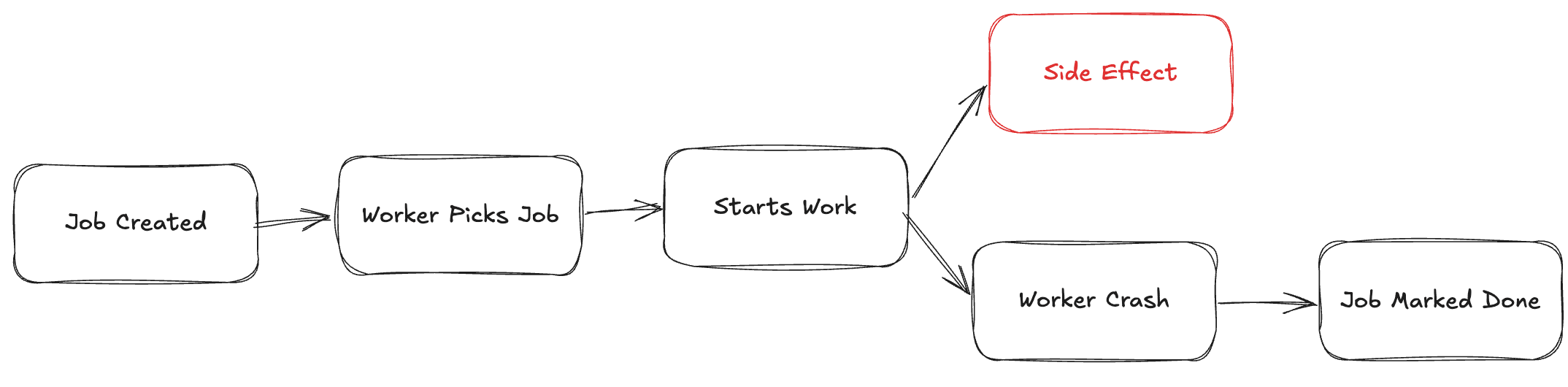
The actual failure
The bug looked like this:
Job picked by worker
External API call started
Worker crashed (OOM / deploy / network)
Job was already marked as “completed”
From the system’s perspective:
everything succeeded
From reality:
nothing happened
No retry.
No error.
No signal.
Just lost work.
Why this happens
Most queue systems don’t guarantee execution.
They guarantee delivery, not completion.
That’s a big difference.
If your logic looks like:
pick job
do work
mark done
You are already vulnerable.
Because crashes don’t follow your control flow.
The mental model shift
Stop thinking:
“Did the job run?”
Start thinking:
“Did the side effect happen?”
That’s the only thing that matters.
Concrete example (The Pain)
Let’s say:
You send an email
Or trigger a payment
Or update a ledger
If your job runs twice → problem
If your job runs zero times → bigger problem

We said “done” too early, and the crash made that a lie.
And both happen more often than people think.
The real fixes (not checklist, but logic)
1. Move “done” after verification
Don’t mark jobs complete when work starts
Mark them complete when outcome is confirmed
2. Idempotency is not optional
If retry breaks your system, your system is already broken.
Example:
Store operation keys
Deduplicate by business ID
Make side effects safe to repeat
3. Separate “processing” from “commit”
This is where most people mess up.
Instead of:
- process → done
Do:
- process → verify → commit
4. Accept that jobs will run multiple times
Design for it.
Don’t try to prevent it.
NestJS angle
If you’re using NestJS + Bull:
The default pattern most people write is this:
@Process()
async handle(job: Job) {
  await this.sendEmail(job.data)
}
This is unsafe.
A better version:
@Process()
async handle(job: Job) {
  const exists = await this.repo.find(job.id)
  if (exists) return

  const result = await this.sendEmail(job.data)

  await this.repo.save({
    jobId: job.id,
    status: 'completed',
    result
  })
}
Now:
retries are safe
crashes don’t corrupt state
The uncomfortable truth
If your background job system looks “clean” and “simple”
You probably haven’t seen it fail yet.
Because when it does, it won’t throw errors.
It will just silently stop doing what you think it’s doing.
Closing line
Failures in APIs are loud.
Failures in background jobs are silent.
That’s why they are dangerous.